
Shop floor management software for fab shops
See where every job is at, who is working on it and what is holding it up, without walking out to the floor to find out. Built for custom fabrication shops by people who ran one.
See if Factory fits your shop.
{{ modeHint }}
Got it. Expect our call.
We'll call you within one business day for a quick five-minute chat.
Want to pick a time instead? Book a demoThe only way to know where a job is at is to walk out and ask.
The whiteboard says Cutting. It said that yesterday. So you walk out, find the job, find the person, and ask. The photo of the problem is on their phone, the note is on a bit of offcut, and the hours they worked on it will come in on paper on Friday. You find things out by walking the floor, and everyone else finds them out by asking you.
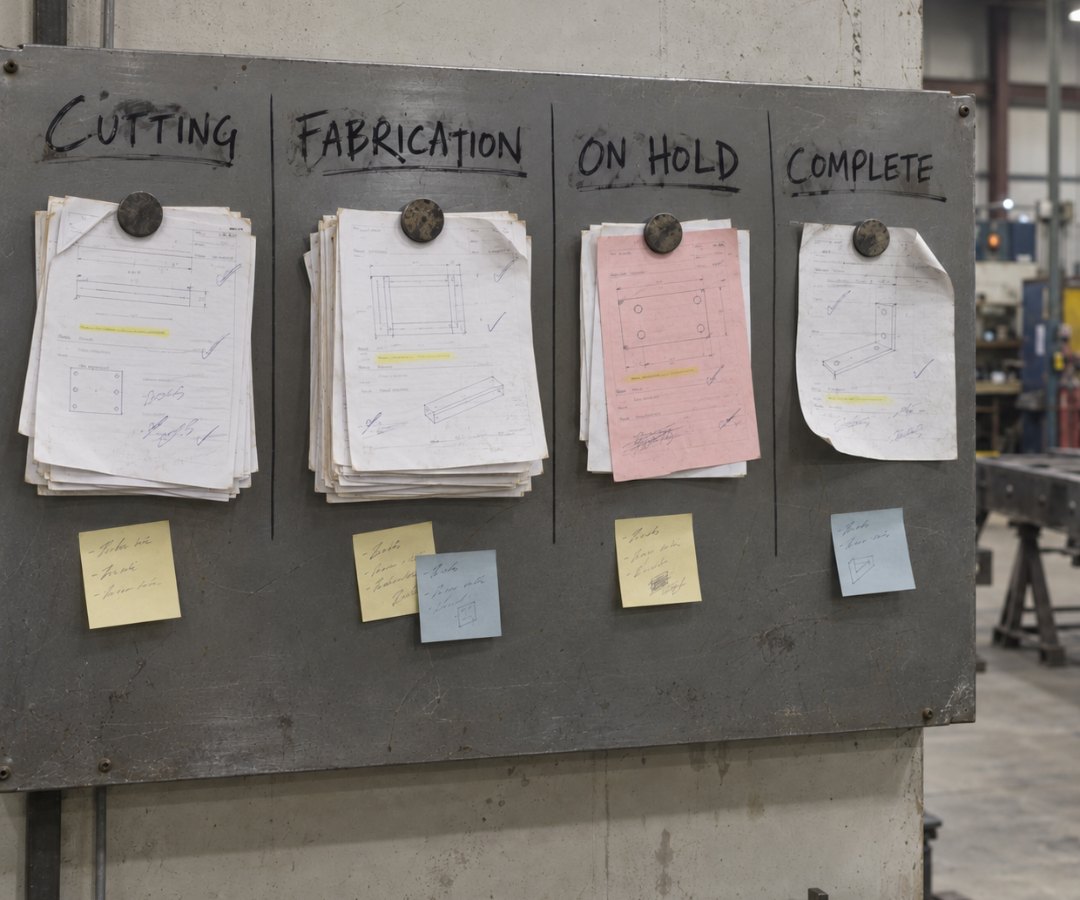
Every job on one board, in the stages your shop actually uses.
A board, with your stages across the top and every live job sitting as a card in one of them. Move a card and everything on it travels with it, the customer, the order number, the labels, the notes and the photos. Open a card and you are in the job itself, with the quote it came from, the hours going on it and the invoice that comes off it.
The photo, the note and the question sit on the job, not in a text.
Something is wrong with a job. Today that is a photo on somebody's phone, a text to you, and a call to the supplier that nobody else hears. In Factory it all goes on the job instead: the photo, the question, and the answer. Six months on, it is still there.
By the time you look at a job, it is already up to date.
A job can carry its own checklists. Open it and you can see what is done, who ticked each step, and who is on it right now.
The board goes wherever the crew goes.
Your crew do not sit at a desk, so the app does not either. The same jobs and the same board sit on the phone in their pocket, so an update goes on the job the moment it happens instead of being remembered later.
Every delivery on one of your trucks, on a day, in order.
A finished job is not a delivered job. Someone still has to get it on a truck. This is the run sheet for your own vehicles: each job goes on a truck, on a day, in the order it goes out, and the driver has the run on their phone. Your trucks and your drivers, not a courier.
The board shows you today. The Planner is where you plan the week ahead.
Same jobs, two screens. You lay the week out on the Planner: who is on what, which day, which machine. Your crew pick their jobs up off the board. When a job runs long or the material is late, you see it on the board first, and the fix is one drag on the Planner.
See production schedulingWhat other fab shops say about us.
"Factory allows me to create a work order, generate invoices, schedule deliveries, manage contacts, and notify customers all in one place."

"My husband, who is not technical at all, can actually jump in and do his own invoices - and now raves about it to all his mates."

"The list of things I love about Factory is long. It's helped us exponentially in our business."
"We've used it for a few years at my other business and found it seamless."

We were in the same position you are.
We ran our own custom fab shop, and every tool out there was an enterprise ERP built for the big 5%, or made by people who never worked in the industry. Nothing fit shops like ours. So we built it ourselves - not just for our shop, but for every custom fab shop that's outgrown the spreadsheet but has no business buying an ERP.
"You're buying from a family that ran a fab shop for almost 50 years - and built the software it always needed."
ML Michael · ran our fab shop for 20+ yrs
A dedicated team gets you live, and stays until it's working.
Real people who've set up hundreds of fab shops. The heavy lifting is on us: we migrate your customers, suppliers, products and pricing, and build out your kits and BOMs, not dump it on your already busy crew.
You explore the platform while we import your customers, suppliers, products and pricing - and agree on the first problems it has to solve for you.
Kits and BOMs built for you, then each person trained on what matters to their role - no one-size-fits-all.
Quotes with clear profitability, job statuses tracked, time on jobs, your accounting integrated and invoices getting paid.
No surprise bills, no being left on your own. We stay with you well past go-live.
The full story, session by session: how we get a shop set up.
Keep the books you already keep.
No switching, no double entry. Connect the accounting package you already run and let quotes, invoices, and payments flow straight through.

Need something of your own? Build it.
Our API is open, so your team can connect Factory to the other tools your shop runs on.
Questions shops ask about shop floor management software
{{ item.a }}
Stop being the only one who knows what is happening on the floor.
See your own jobs on the board, in your stages, with the notes, photos and hours sitting on them. Bring a job you are building this week and we will run it live.
PENDING · a floor-visibility testimonial (§07 has none)
REGISTERED · /platform/shop-floor-management + /au/platform/shop-floor-management (AU copy Sep 9), superseding the old Run The Floor page · own HubSpot form pair wired per region (data-campaign="shop-floor-management")